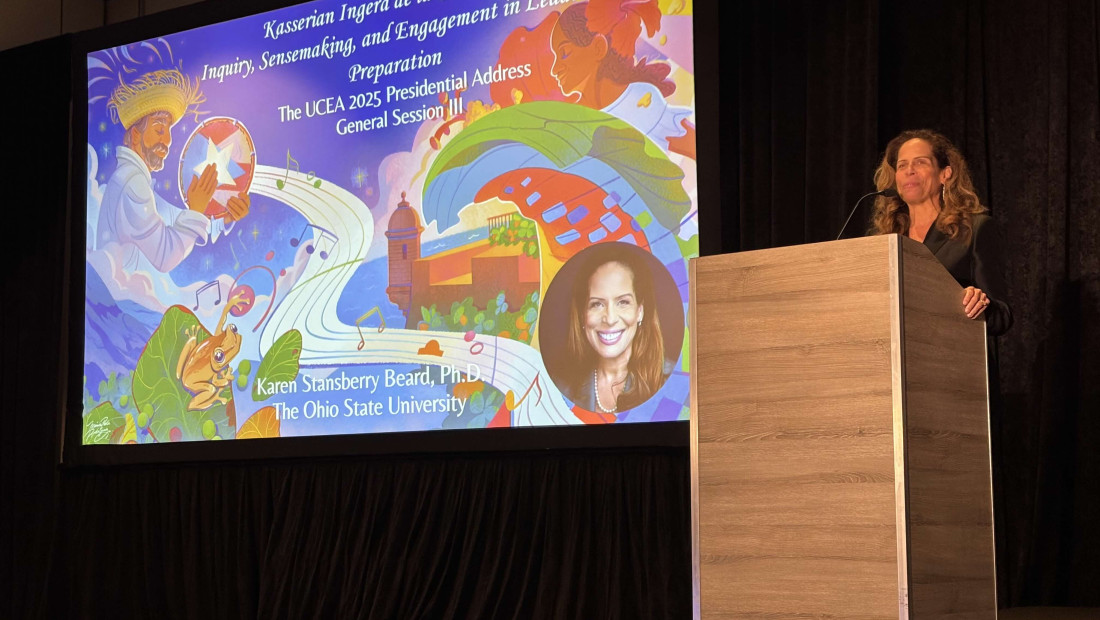
As president of the University Council for Educational Administration, Karen Stansberry Beard addresses annual conference participants during her last speech of her term.
Faculty, educators, grad students benefit from UCEA membership
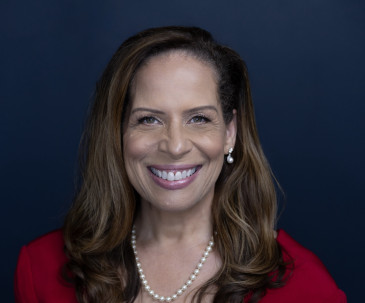
When Karen Stansberry Beard first joined the University Council for Educational Administration (UCEA) as an Ohio State University graduate student, it was a lifeline — a place to find mentors, work on research that showcased best practices for the profession and to dream big — all on a national platform.
Now with an international membership, UCEA focuses on “building knowledge for the field and providing quality preparation and lifelong learning experiences for school and school system leaders,” according to its website.
Universities are members, each with a Plenary Session Representative. University faculty belong, as do district school leaders, who appreciate the council’s research-based professional development opportunities.
Graduate students aspiring to faculty roles in educational leadership and policy also join for the unique mentorship opportunities and community UCEA affords.
“Coming out of the public school system as first a teacher, then a principal, I knew very little about the national field,” Beard said.
She had earned a superintendent’s certificate, but she realized her potential reach as university faculty would be greater than as head of a school district.
“Becoming a graduate scholar at Ohio State, then being nominated for the David L. Clark and Barbara Jackson Scholars Networks with UCEA, set me up for a career I don’t think I could have otherwise had,” she said.
This past November, the associate professor of educational administration completed her most prestigious service role to date: her yearlong term as the first current Ohio State faculty member to serve as the council’s president.
Professor Emeritus Wayne Hoy, who was Karen’s advisor during her doctoral work, saw Beard as ideal for council president.
“Karen’s background shows that she has studied the theory of education administration and practiced it during her many years with Columbus City Schools,” he said. “As faculty, she’s conducted her own research and published it in the best journals in the field.”
“I think, legitimately, you can say she's one of the rare people who keeps one foot in each camp: in theory and research, as well as the world of practice. So, it made sense for her to head the leading research theory and practice organization in the country.”
Beard highlights the benefits of council membership
The university council benefits education by bringing the best research and knowledge forward to teachers and school administrators.
As Beard said in her fourth and final presidential address to the council membership at the annual November conference, “We need action at every level (of education) — backed by data, shaped by what families say they need and committed to ensuring that all young people have the chance to succeed.”
“When we get it right, we are not just helping children — we are strengthening the workforce, reducing long-term costs, and building a better future for everyone in each community.”
Hoy, who was president of UCEA while a professor at Rutgers, encouraged Beard to join when she was his graduate student advisee.
Membership launched Beard onto a national stage, she said, where she had a chance to demonstrate her growing expertise.
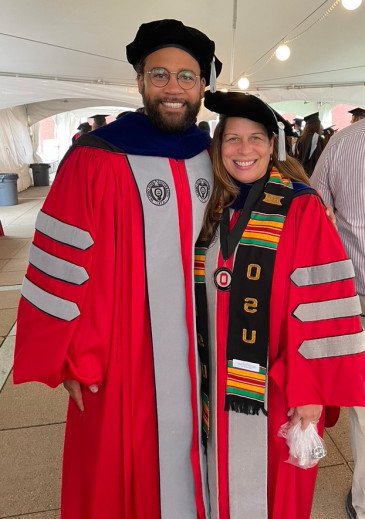
She engaged with UCEA’s scholar communities for graduate students and encourages current graduate students to join. “Graduate student members meet faculty experts from across the nation and are mentored by them,” Beard said.
They also gain opportunities like those she enjoyed. For instance, on committees, she oversaw the review process for accepting conference presentations and connected with other doctoral students and faculty experts for collaborative research projects. Graduate student members learn to excel as future organizational leaders.
With this in mind, Beard set a goal during her presidency of inviting and engaging in consistent and efficient communications with the council’s graduate student communities.
“Now our graduate student council meets with the council’s executive committee twice a year,” she said, “and their monthly meeting minutes are given to the president, so everyone on the executive committee is informed and can support what graduate students are doing.”
“We want to recognize the work of these students, who are working so hard.”
Beard also streamlined several administrative functions of the council, ensuring an efficient organization, better able to serve its members. For instance, she created development opportunities, community processes and a permanent organizational ombudsperson.
“Now, if an issue arises, we know how to address it. If it is outside the scope of the board’s assigned work, we aren’t diverted from fulfilling our responsibilities.”
Building on the university council’s legacy at Ohio State
Headquarters for the University Council for Educational Administration was officially launched in 1955 at Ohio State with support from the W. K. Kellogg Foundation. A small, full-time staff was hired under the leadership of Executive Director Jack Culbertson.
Before his official arrival, Culbertson met with the college’s Professor John Ramseyer, who shared with him his deep interest in the council’s future.
It seemed that Ramseyer was the reason the council leaders decided to move its headquarters to Ohio State. Culbertson wrote in his book, Building Bridges: UCEA’s First Two Decades, “He was esteemed by colleagues both locally and nationally.”
The council’s formalization came at a time when the American Association of School Administrators identified several concerns. “One was the rapid growth in schools coupled with a limited supply of administrators. Another was the heavy pressures on superintendents,” (Building Bridges, p. 23) Culbertson wrote.
Culbertson guided the organization for 21 years, ensuring it contributed significantly to the field. Which brings us to today.
Beginning here at Ohio State, Beard has engaged in UCEA governance for more than 20 years. She has carried on the university’s legacy of uplifting the work of the council and the field of educational administration and policy.
Now as immediate past president, she is the council’s treasurer, a role with much responsibility.
“UCEA has established its legacy as a place of hope that multitudes have looked to for the past 70 years,” Beard said. “It is our responsibility to continue that legacy.”