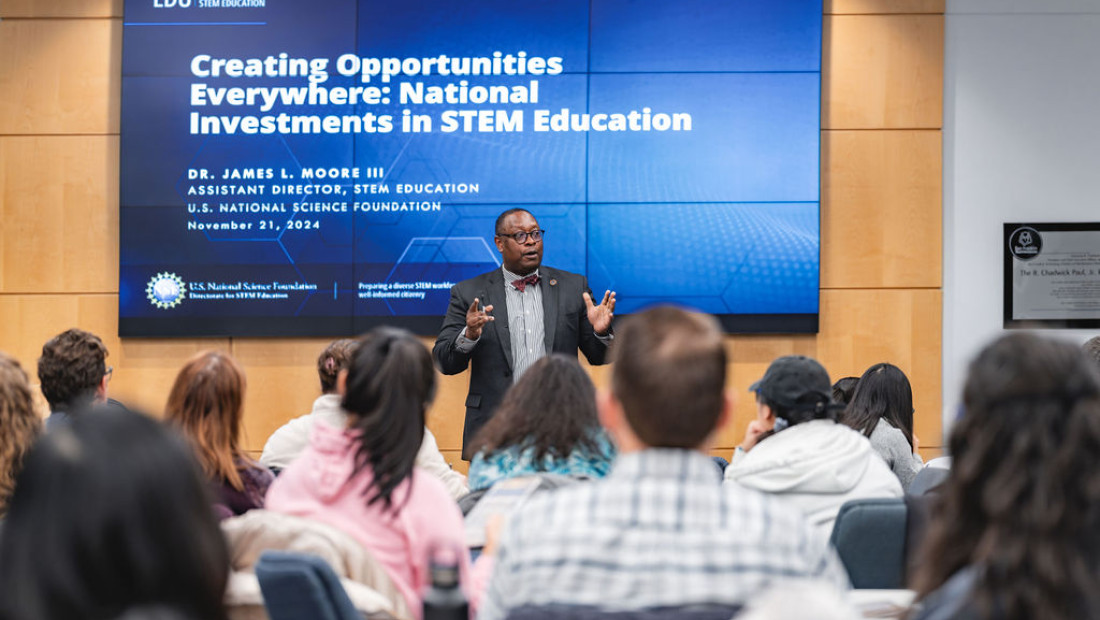
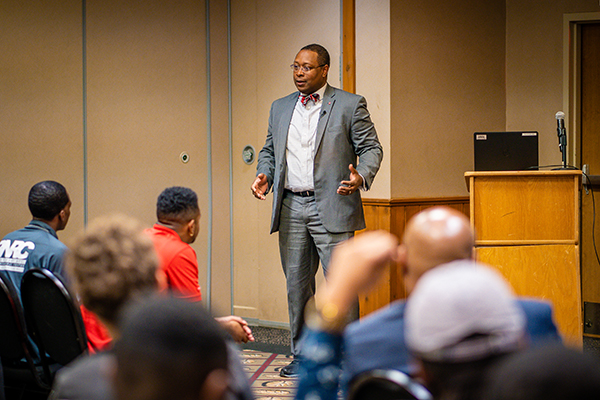
James L. Moore III visits Lehigh University to discuss opportunities in STEM education with faculty and staff. Courtesy of Lehigh University, photographer Marcus Smith
Moore is only Ohio State faculty currently bestowed this honor
When James L. Moore III joined the college in 2002 as a new assistant professor of counselor education, he never imagined the heights to which he would rise.
Now, 23 years later, the college’s Distinguished Professor of Urban Education has earned innumerable, prestigious awards.
In the last few years alone, he was:
- named a Living Legend by the National Alliance of Black School Educators
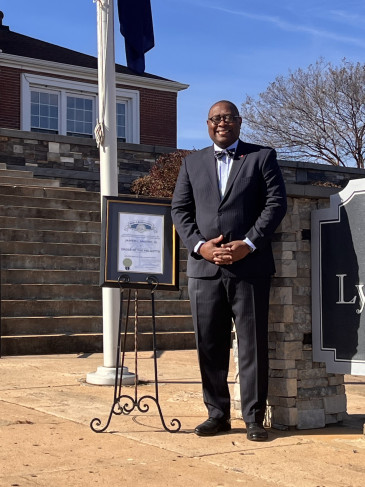
- bestowed South Carolina’s highest civilian honor, the Order of the Palmetto
- received Emerald Publishing’s Emerald Literati Award for Outstanding Author Contribution
- inducted as a Fellow by American Association for the Advancement of Science
- received the S. Kent Butler Transformative Impact Award from the American Counseling Association
- ranked yearly, since 2018, among the top 200 United States scholars known for their influence of public education
Now, the National Academy of Education has elected him to join its ranks, one of the highest honors in education research and policy.
The organization offers the rare opportunity to just over 330 scholars from across the United States and abroad.
Moore stands out as the only current Ohio State faculty member of the academy. He is also the only current academy member in the state of Ohio.
“James L. Moore III exemplifies the highest ideals of academic and research excellence in the College of Education and Human Ecology through his decades of distinguished scholarship and service as a national leader in counselor education,” said Erik Porfeli, interim dean of the college. “His insights have shaped the field, guided countless practitioners, positively impacted the lives of many people, and elevated our university’s mission."
"Equally inspiring is his visionary leadership of the NSF directorate to advance STEM education nationwide. His stewardship strengthens pathways for future innovators, helping to ensure that our country has the STEM person-power to grow and thrive.”
Supporting STEM education and education research at NSF
Following Moore’s appointment in the Directorate of Engineering at NSF as a program director from 2015 to 2017, five years later, he was selected to serve as assistant director for the Directorate of STEM Education (formerly Directorate of Education and Human Resources).
On leave from the university, he focuses on ensuring that more people are prepared — through research into best teaching practices and technology — for the growing demands for a skilled STEM workforce.
Why is STEM education important? The reason is highlighted by the Bureau of Labor Statistics in its projected growth in jobs. For 2022-2032, employment in STEM occupations is expected to grow 7%, which is faster than the 2% growth for non-STEM occupations.
The work of NSF is held in high esteem worldwide. “People all over the world see NSF as the conduit for being at the top of engineering and scientific innovation,” Moore said.
“We hosted a delegation from Finland that came to learn from us. Singapore also depends on our research to improve teaching and learning. They’re at the top in the industrial world in terms of educational outcomes, but they depend on research and development produced in the United States,” he said.
Maintaining role as Ohio State professor
Despite his elevated role at the NSF, Moore has always valued his many former senior leadership roles and has consistently maintained laser focus on his professorship at Ohio State. Throughout his career, he has received more than $50 million in grants, gifts for projects, and contracts to advance education.
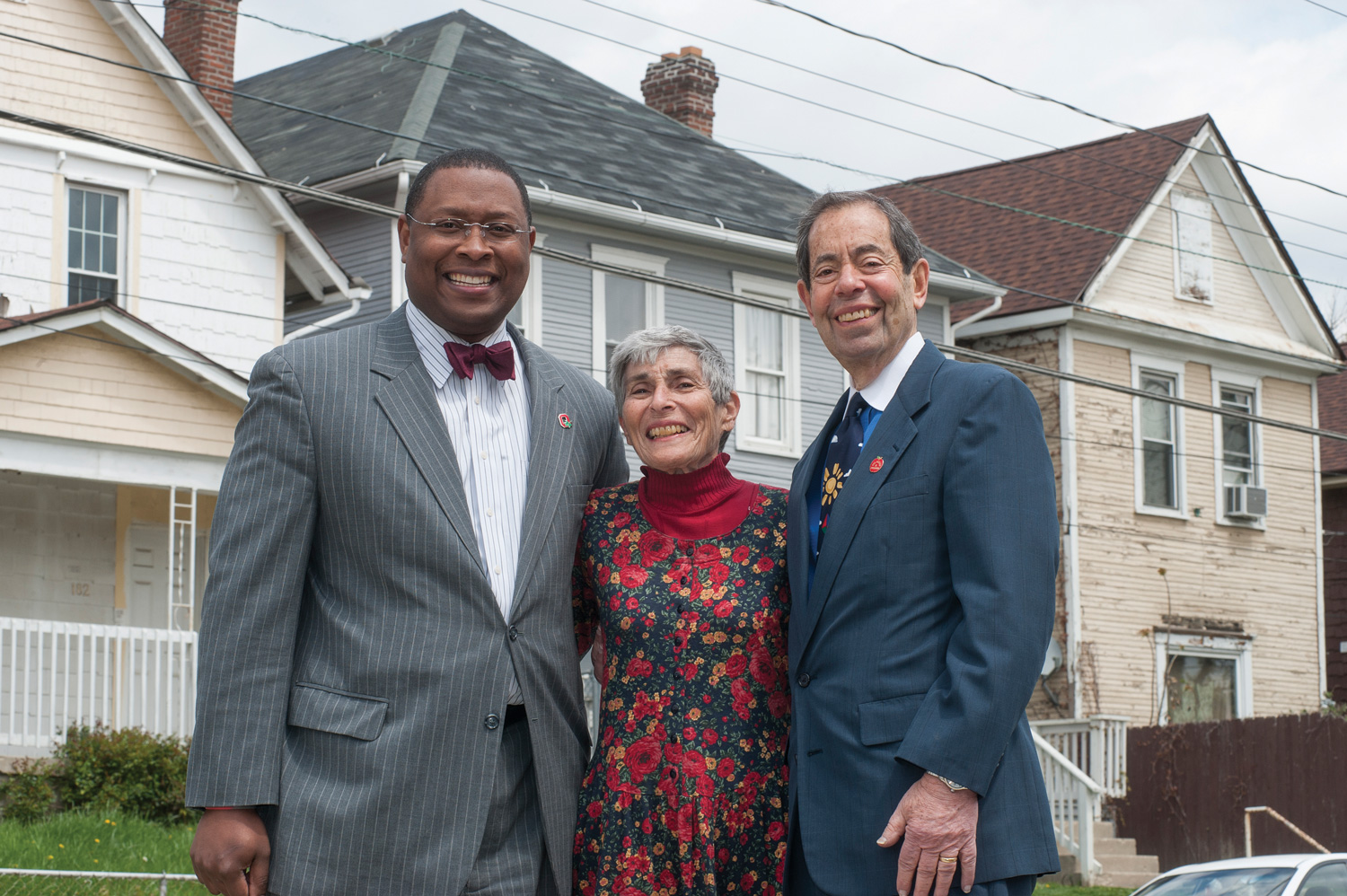
For instance, Moore treasures the many gifts that he has received since 2013 by donors Bob and Missy Weiler. He considers the Weilers an extension of his family and a significant reason why he has been able to achieve career milestones and receive highly coveted honors and distinctions.
The Weilers clearly possess similar feelings of admiration and respect for Moore. In 2018, they created in his honor the Dr. James L. Moore III Scholars Program, supporting Columbus State Community College students who transfer to Ohio State. My gift details - Make your gift to The Ohio State University
Moore has published in top-tier journals for years and continues to do so with colleagues while maintaining a busy schedule at NSF. He has authored or co-authored more than 180 publications, which have been cited by other scholars more than 10,500 times, according to Google Scholar.
Nominator highlights Moore’s contributions
Okhee Lee, Moore’s nominator for the academy and the Peter L. Agnew Professor of Education at New York University’s Steinhardt School of Culture, Education and Human Development, summed up his qualifications.
“Dr. Moore is a household name in many circles of influence at multiple levels,” she wrote in an email, giving four points about the breadth of his work:
- “His research and scholarship are expansive across the fields of counseling, STEM education, culture, and social behavior. His work is widely known among education researchers, social science researchers and behavioral science researchers.”
- “His work has enabled the advancement of important education policy and practice at the local, state and federal levels, and also for international jurisdictions.”
- “His scholarship spans broadly across pre-K-12 education, postsecondary education, philanthropy, and government.”
- “He frequently appears in popular publications and makes public impacts.”
“Through the nexus of education research, policy, and practice,” Lee wrote, “his efforts focus on removing systemic barriers to student success and creating equitable opportunities for all learners.
Two examples of STEM initiatives impacting the nation, the world
SafeInsights
Since Moore joined the NSF, his directorate has funded existing initiatives and created new ones. A good example is the Experiential Learning for Emerging and Novel Technologies program.
Funding comes from a partnership between Moore’s directorate and the Directorate of Technology, Innovation and Partnerships — also part of the NSF — as well as the Micron Foundation.
In September 2025, Moore announced to principal partner Rice University — called SafeInsights — a first-of-its-kind NSF research hub to transform learning and education research.
“This project is expected to bring us to the new frontier of educational research,” Moore said. “One of the grand challenges we’ve had, particularly in K-12 spaces, is getting research results to teachers and ensuring they know how to use it to advance critical STEM teaching and learning in classrooms across the U. S.”
The grant supports 80 institutions and partners across the nation in building this secure research platform and community, according to the SafeInsight website. Schools will use it to gain access to research so they can teach their students for best results.
Researchers also will gain insights into what works best for different learners and creates content that empowers educators.
The content will arrive at schools and for students, which will add research-backed features. Additionally, cutting-edge science will be available to educators and their students. Eventually, SafeInsights expects tens of millions of U.S. students to benefit — across all educational levels.
“If it does what we hope,” Moore said, “it will move educational research and teaching and learning to another sphere.”
National AI Research Institutes: Speech and language professionals
The AI Screener for speech and language professionals will make universal early screening of speech- and language-related issues possible for all U.S. public schools. AutoRSR, the tool funded by Moore’s work at the directorate, is now available free of charge to anyone with a computer access.
Another example of STEM work that Moore’s directorate funds is NSF’s National Artificial Intelligence Research Institutes. “NSF has been making investments in AI since the 1960s, and the agency hopes to continue to move to the new frontier in its investments,” he said. “Five of the 27 AI institutes (funded by NSF) focus on education.” The directorate looks for gaps to fill in STEM education, and one is glaring from Moore’s perspective.
“There’s a dearth of speech and language professionals across the United States,” he said, “particularly in some of the most vulnerable, under-resourced school systems.”
“If your school is fortunate enough to have such a professional, they might be able to provide an assessment of students, but often, they’re overwhelmed by the number needing individualized interventions.”
Recognizing this, Moore’s directorate funded the University at Buffalo to create the National AI Institute for Exceptional Education (AI4ExceptionalEd).
Partnering with eight other institutions, the university is developing two AI solutions to help with speech-and-language pathologists.
The AI Screener will make universal early screening of speech- and language-related issues possible for all U.S. public schools.
The AI Orchestrator will enable speech-and-language pathologists to use their time to help children more effectively and to adopt evidence-based interventions customized for each child’s Individualized Education Program.
The institute will work with other leading research universities, school districts and nonprofits to develop, test and scale these new AI systems.
“We are very grateful for Dr. Moore’s support of our project while he is working at NSF,” said Jinjun Xiong, PhD and scientific director of the AI4ExceptionalEd Institute and SUNY Empire Innovation Professor at University at Buffalo.
“By taking a human-centered design approach, we have developed an evidence-based screening tool, called AutoRSR, which has been validated to achieve a similar level of accuracy compared to human-conducted screening."
“The tool is now made available free of charge to anyone with a computer access. We’re now working with a local school district to deploy this screening tool for children aged 5- to 9-years-old."
"The institute also developed a number of intervention tools for AI Orchestrator, and we are in the process of further validating and refining their results before wide deployment. We’re on target to deliver our promises to NSF and IES (Institute of Education Sciences), which jointly funded our research at the institute.”
The aforementioned examples offer a glimpse of Moore’s broader work at NSF by illustrating some of the magnitude and significance of the investments made under his leadership. He is a prominent education researcher and leader in STEM and non-STEM circles in the United States and beyond, which makes the case for why he was elected to the National Academy of Education.